
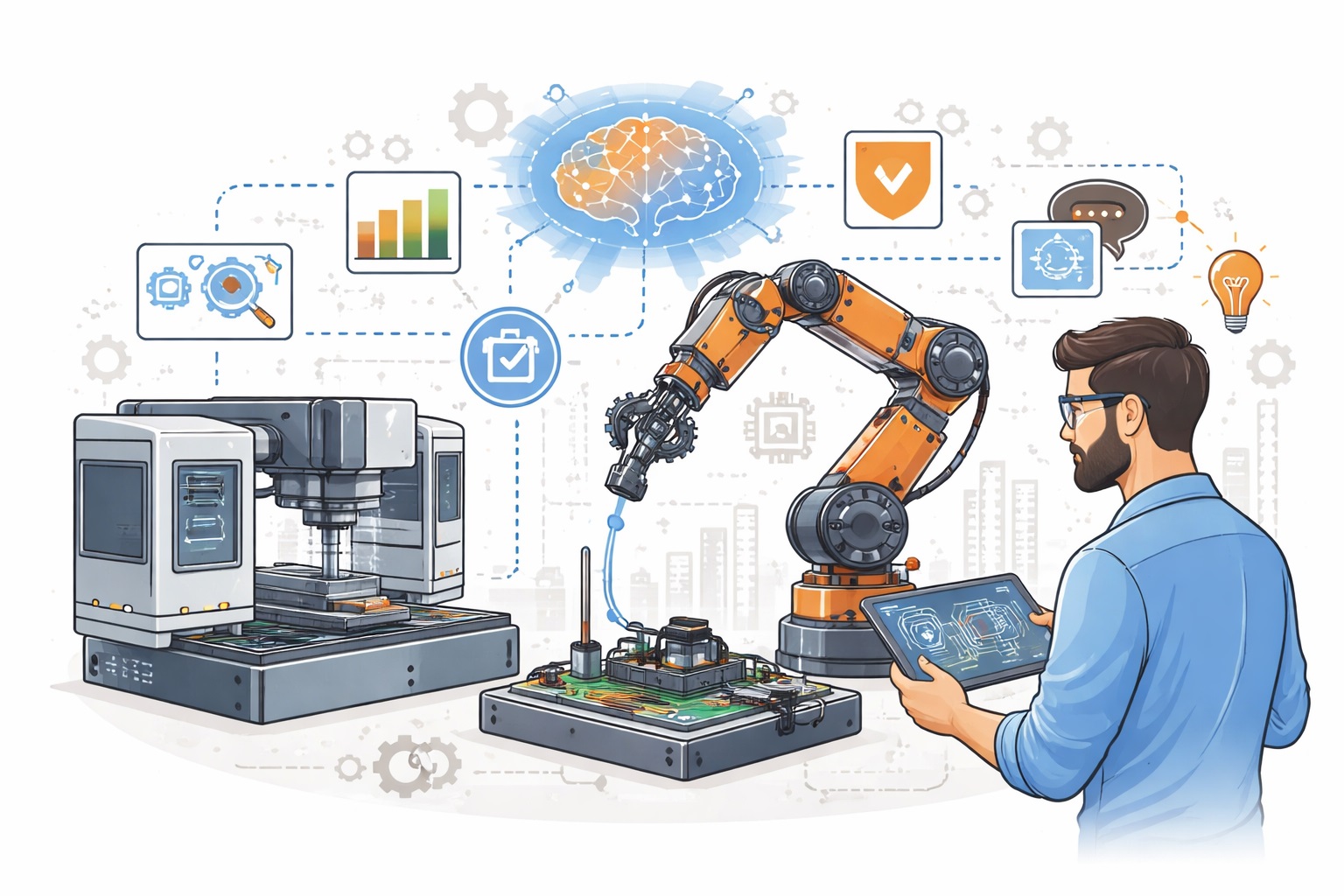

Introduction
Electronics and tech businesses are already built around innovation. Whether you are involved in manufacturing, distribution, repair services, or hardware sales, your business deals with data, processes, and precision every day.
Now, Artificial Intelligence (AI) is becoming the next layer of that innovation.
Many business owners think AI is only for software companies. But in reality, AI is creating significant value in electronics and hardware-related businesses as well.
The key is not just knowing what AI is—but understanding where it fits into your operations.
What AI Means for Electronics Businesses
In simple terms, AI helps systems:
- Analyze data faster
- Detect patterns
- Make decisions
- Automate processes
For electronics businesses, this translates into:
- Better quality control
- Smarter production planning
- Improved inventory management
- Faster customer service
Where AI Can Be Applied in Electronics Businesses
AI is not a single tool. It can be applied across multiple areas of your business.
1. Quality Control & Defect Detection
Quality is critical in electronics. Even small defects can lead to major issues.
Traditional inspection methods:
- Manual checks
- Random sampling
- Time-consuming processes
AI can improve this significantly.
What AI Can Do
- Analyze product images or sensor data
- Detect defects in real time
- Identify patterns in recurring issues
Example Idea
An AI-powered system could:
- Scan circuit boards during production
- Flag micro-defects that are hard to detect manually
- Reduce defective products reaching customers
This improves both quality and brand reputation.
2. Predictive Maintenance of Machines
Machine downtime can be costly.
Instead of waiting for machines to fail, AI can predict problems in advance.
What AI Can Do
- Monitor machine performance
- Detect unusual behavior
- Predict when maintenance is needed
Example Idea
An AI system could:
- Track temperature, vibration, or usage patterns
- Alert your team before a breakdown occurs
This reduces downtime and maintenance costs.
3. Inventory & Supply Chain Optimization
Electronics businesses often deal with:
- Multiple components
- Supplier dependencies
- Demand fluctuations
Managing this manually can lead to:
- Overstocking
- Stockouts
- Delays
What AI Can Do
- Forecast demand
- Optimize inventory levels
- Suggest reorder timing
Example Idea
An AI system could:
- Analyze past sales and seasonal trends
- Predict which components will be needed
- Help you avoid excess or shortage
4. Production Planning & Efficiency
Production planning in electronics involves many variables:
- Component availability
- Workforce
- Machine capacity
AI can help optimize these factors.
What AI Can Do
- Suggest optimal production schedules
- Identify bottlenecks
- Improve resource utilization
Example Idea
An AI system could:
- Adjust production plans based on real-time data
- Improve output without increasing costs
5. Customer Support & After-Sales Service
Electronics businesses often receive:
- Installation queries
- Troubleshooting requests
- Warranty-related questions
Handling these manually takes time.
What AI Can Do
- Provide instant responses to common queries
- Guide customers through troubleshooting steps
- Route complex issues to the right team
Example Idea
An AI assistant could:
- Help customers diagnose basic device issues
- Reduce service workload
- Improve customer satisfaction
6. Sales & Demand Insights
Understanding customer demand is critical.
AI can analyze:
- Sales data
- Customer behavior
- Market trends
What AI Can Do
- Identify best-selling products
- Suggest pricing strategies
- Highlight slow-moving inventory
Example Idea
An AI system could:
- Recommend which products to promote
- Help your sales team focus on high-value opportunities
7. Fraud Detection & Risk Monitoring
In electronics distribution or e-commerce, risks include:
- Fake orders
- Payment fraud
- Warranty misuse
What AI Can Do
- Detect unusual transaction patterns
- Flag suspicious activities
- Reduce financial risks
8. Product Development & Innovation
AI can also support R&D.
What AI Can Do
- Analyze market needs
- Study competitor products
- Suggest improvements
Example Idea
An AI system could:
- Identify features customers are demanding
- Help design better products
Benefits of AI for Electronics Businesses
1. Improved Quality
Fewer defects and better product reliability.
2. Reduced Costs
Less waste, fewer errors, and optimized operations.
3. Faster Operations
Automation speeds up processes.
4. Better Decision Making
Data-driven insights improve planning.
5. Competitive Advantage
AI-enabled businesses move faster and smarter.
Challenges to Consider
AI is powerful, but implementation needs planning.
1. Data Availability
AI needs good-quality data to work effectively.
2. System Integration
Existing tools and machines must be connected properly.
3. Initial Investment
Some AI solutions require upfront investment.
4. Skill Gap
Teams may need training to use AI tools effectively.
Important Insight: AI is Not One-Size-Fits-All
Every electronics business is different.
- A manufacturer has different needs than a distributor
- A repair service has different workflows than a retailer
AI solutions must be:
- Customized
- Integrated with existing systems
- Aligned with business goals
This is where many businesses face challenges.
How to Start with AI in Your Business
A practical approach works best.
Step 1: Identify Pain Points
Look for:
- Frequent errors
- Delays
- Manual work
Step 2: Prioritize High-Impact Areas
Start with areas that:
- Affect revenue
- Consume time
- Impact customer experience
Step 3: Explore Solutions
Understand what is possible with AI.
Step 4: Implement Gradually
Avoid trying to automate everything at once.
Why Expert Guidance Matters
AI implementation in electronics businesses is not just about tools.
It involves:
- Understanding workflows
- Connecting hardware and software systems
- Designing efficient processes
Without proper planning:
- AI may not deliver expected results
- Systems may become complex
- ROI may be unclear
Working with experienced teams helps ensure:
- Correct implementation
- Better results
- Faster adoption
Future of AI in Electronics Industry
AI will play a major role in shaping the future of electronics businesses.
What to Expect:
- Fully automated production lines
- Smarter supply chains
- AI-driven quality control
- Faster product innovation
Businesses that adopt AI early will have a strong competitive edge.
Conclusion
AI is no longer limited to software companies. It is becoming a powerful tool for electronics and tech businesses as well.
From quality control to supply chain management, AI can improve efficiency, reduce costs, and enhance decision-making.
The key is not to implement everything at once, but to start with the right areas and build gradually.
Understanding the possibilities is the first step.
Implementing them effectively is where real business value is created.
FAQs
How is AI used in electronics manufacturing?
AI is used for quality inspection, predictive maintenance, and production optimization.
Can small electronics businesses use AI?
Yes, AI solutions can be scaled based on business size and needs.
Is AI expensive to implement?
Costs vary, but starting with focused use cases is possible.
What is the biggest benefit of AI in electronics?
Improved efficiency, reduced errors, and better decision-making.